Blocked Drains Wollongong
If your drains only misbehave when it rains, that is not a coincidence in Wollongong. The Illawarra wastewater network is built around storm-event overflow, and two of its treatment plants run only in wet weather. Here is what that means for your property, and what actually fixes it.
Plumbing Creations clears blocked drains across the Wollongong LGA using CCTV drain camera inspection, high-pressure jet rodding, electric eel and root cutting. Wollongong is serviced by Sydney Water. The Illawarra wastewater system is explicitly designed around storm-event overflow: Sydney Water operates the Wollongong water resource recovery facility as the main plant, with the Bellambi and Port Kembla plants each described as only receiving flow during storm events. Wollongong City Council maintains five main flood catchments relevant to drainage: Hewitts Creek at Thirroul and Bulli, Collins Creek between Bellambi and Bulli, Towradgi Creek at Corrimal, Allans Creek at Figtree and West Wollongong, and Mullet Creek at Dapto. The NSW SES describes Wollongong flooding as dominated by flash flooding, with streams responding very quickly to high-intensity rainfall and escarpment runoff an identified mechanism. Typical Wollongong blocked drain prices: basic clearing $150-$250, jet rodding $250-$450, CCTV drain camera inspection $250-$400, root cutting and clearing $350-$650, emergency after-hours callout $180-$300.
Why Wollongong drains block the way they do
Start with the one fact that explains most wet-weather drain calls here. Sydney Water operates three treatment plants on the Wollongong system, and it describes two of them, Bellambi and Port Kembla, as only receiving flow during storm events. In other words, the network is deliberately engineered on the assumption that heavy rain will push more into the sewer than the normal system can carry, and there are dedicated wet-weather plants standing by to take the overflow. If your gully overflows or your toilet gurgles during a downpour, you are seeing the property-level end of a network-level design characteristic, not a random fault.
That has a practical consequence most homeowners are never told. Stormwater is not supposed to enter the sewer, but in older Wollongong properties it constantly does, through cracked inspection openings, unsealed gully surrounds set too low, downpipes illegally connected to the sewer line decades ago, and damaged junctions taking groundwater. Each of those is a small contribution on its own and the network absorbs it. In a storm they all arrive at once. Sealing the property's own inflow points is usually the cheapest, most durable fix available to an individual owner, and it is the first thing we look for on a wet-weather blockage.
The second Wollongong-specific factor is speed. The NSW SES states that flooding in the Wollongong LGA is dominated by flash flooding, that streams respond quickly to high-intensity rainfall, and that flooding can begin very soon after heavy rain starts. Behind most of the coastal strip sits an escarpment several hundred metres high with almost no absorption capacity. That means your stormwater system does not get a gentle ramp-up, it gets everything at once. Drains that cope perfectly with a normal wet week will surcharge in twenty minutes during an escarpment event.
Wollongong City Council has mapped five catchments that matter for drainage work, and each names real problem locations. Hewitts Creek covers Thirroul and Bulli, where Council names Lachlan Street, The Esplanade, the Corbett Avenue and Hamilton Road area, Black Diamond Place and the Bulli railway culvert. Collins Creek runs fourteen square kilometres between Bellambi and Bulli, naming the Ursula Road area and Kells Crescent. Towradgi Creek covers Corrimal and names Lemrac Avenue and the Pioneer Road and Willow Grove area. Allans Creek covers Figtree and West Wollongong and names Koloona Avenue, Darragh Drive and Arrow Avenue. Mullet Creek covers Dapto and names Burringbar Street. Knowing which one you are in changes what a realistic fix looks like.
Then there is pipe age, which in Wollongong varies enormously street by street. The northern suburbs subdivided around the collieries, with Thirroul's growth accelerating after 1906, so vitrified clay sewer with root intrusion at the joints is the norm in the older pockets. Figtree, by Council's own account, was urbanised by the 1970s, which puts it in the clay-to-early-PVC transition. Dapto's schools were built between 1958 and 1969, marking its main growth. West Dapto and Horsley are almost entirely modern PVC. So the same symptom, a slow drain, has a completely different diagnosis and cost depending on which of those you are in, which is exactly why we run a camera before quoting rather than after.
What we actually do about it depends on what the camera shows. Roots in clay joints get cut and jetted, then we tell you honestly whether the pipe is worth relining or whether cutting will just be an annual appointment. Grease and scale gets jetted. A collapsed or dropped section needs excavation or a liner and there is no clever way around it. Stormwater inflow gets sealed at the source. A blockage in the Sydney Water main rather than your line is Sydney Water's responsibility and we will tell you so rather than charging you to dig.
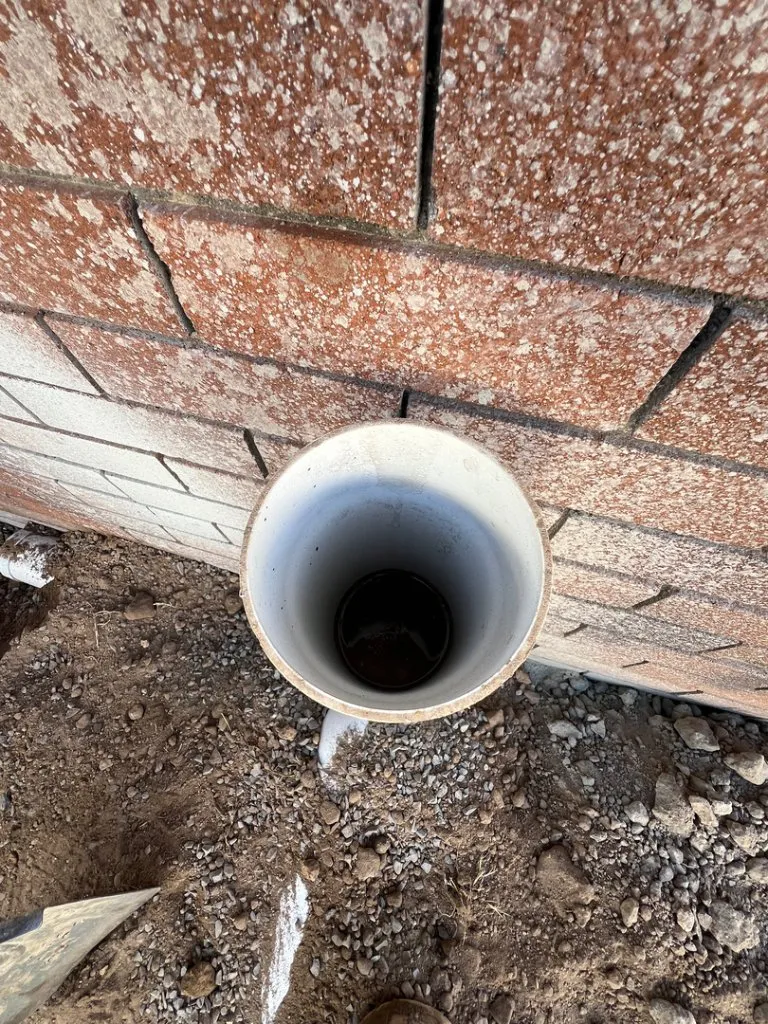
Signs it is inflow, not a blockage
- Problems only appear during or just after heavy rain
- Gully overflows but drains fine on a dry day
- Toilets gurgle when it rains, not when appliances run
- Multiple fixtures slow at once, then clear on their own
- A downpipe or yard drain visibly runs into a sewer gully
Blocked drain prices in Wollongong
Quoted before we start. What moves the price is access, pipe material and whether the blockage is a clean-out or a structural failure.
| Job | Typical price | What drives it |
|---|---|---|
| Basic drain clearing | $150–$250 | Accessible opening, straightforward blockage |
| High-pressure jet rodding | $250–$450 | Grease, scale and heavier root matter |
| CCTV drain camera inspection | $250–$400 | Diagnosis and a recording you keep |
| Root cutting and clearing | $350–$650 | Common in clay sewer in the older suburbs |
| Emergency after-hours callout | $180–$300 | Sewage overflow, 24/7 |
| Excavation or pipe relining | Quoted per site | Collapsed or dropped sections |
These are typical price ranges for the Illawarra and NSW, drawn from published 2026 industry pricing data — not a quote, and not our fixed prices. What your job actually costs depends on access, the age and condition of the plumbing, parts, and whether it is after hours. We give you a fixed price before we start work, so you are never guessing. Prices last reviewed 23 August 2026.
Blocked drains in Wollongong: common questions
Why do my drains only block when it rains?
Almost always because stormwater is getting into the sewer line somewhere on the property. Cracked inspection openings, gully surrounds set too low, downpipes connected to the sewer decades ago and damaged junctions taking groundwater all contribute. The Illawarra network is designed with that overflow in mind, with Sydney Water running the Bellambi and Port Kembla plants only during storm events, but at property level the surcharge shows up in your gully or your toilet. Sealing the inflow points is usually the cheapest lasting fix.
Is the blockage my responsibility or Sydney Water's?
Broadly, the pipework on your side of the connection point is yours and the main is Sydney Water's. A CCTV inspection usually settles it quickly, because we can see where the line stops being your problem. If the blockage is in the main we tell you and you call Sydney Water rather than paying us to excavate. We would rather lose the excavation job than charge you for someone else's pipe.
Will root cutting fix it permanently?
Not usually, and we will say so. Cutting clears the roots that are there now, but if they entered through a failed joint in vitrified clay, they will come back, typically within twelve to twenty-four months. The permanent options are relining the affected section or replacing it. We will show you the camera footage and let you decide whether an annual cut is acceptable or whether it is time to fix the pipe.
What sewer pipe is likely under my Wollongong house?
It depends on the suburb and the decade. The older northern suburbs subdivided around the collieries, with Thirroul growing quickly after 1906, so vitrified clay is common there. Figtree was urbanised by the 1970s according to Council, putting it in the clay-to-PVC transition. Dapto grew mainly between 1958 and 1969. West Dapto and Horsley are modern PVC. Clay is where root intrusion happens; PVC blockages are usually foreign objects, grease or fall problems.
Do you do emergency blocked sewer callouts?
Yes, 24/7. Sewage surfacing in a yard or backing up inside is a health issue as well as a plumbing one and should not wait until morning. Call 0411 360 263 and we will tell you honestly on the phone how long we will be, plus what to do in the meantime to limit the damage.
Can you tell me which flood catchment I am in?
We can point you to the right one. Wollongong City Council publishes catchment pages for Hewitts Creek, Collins Creek, Towradgi Creek, Allans Creek and Mullet Creek, each with named problem locations and current studies. Which one applies affects your flood planning level and what property-level drainage work is worth doing. We check it before quoting stormwater work.
Drain blocked in Wollongong?
CCTV before we quote, so you know what you are paying for. 24/7 for sewage overflows.
Call 0411 360 263